Succession planning is one of the most important decisions a leadership team makes, and one of the hardest to get right. Gartner reports that only 38% of chief HR officers are confident they can deliver on their succession goals in the next year, and only 35% of organisations select successors who fit future needs. McKinsey notes that nearly half of executives are considered to be failing within two years of stepping into a new role. The problem is rarely a lack of talent. It's that too many talent reviews are driven by the rear-view mirror.
Performance looks back. Potential looks forward.
Most talent reviews use some version of the 9-box grid, which places people on two scales: performance and potential. In practice, many reviews start with performance and then work out potential from it. “She's delivered, so she must be ready.” That treats potential as a reward for past results rather than a judgement about future value.
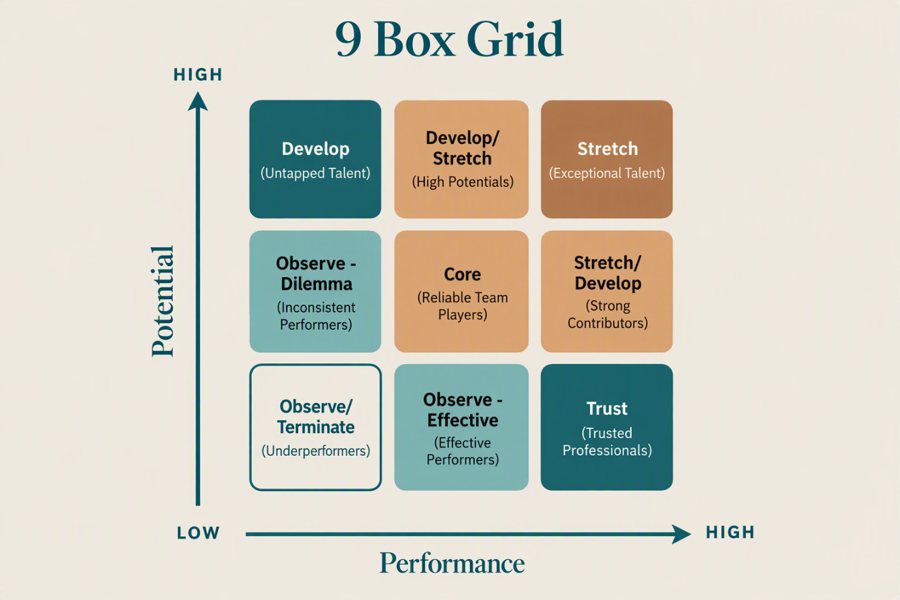
The two are not the same. Research from the Corporate Executive Board (now part of Gartner) found that only about 15% of high performers are also high potentials. Performance tells you what someone delivered in familiar conditions. Potential tells you who can handle more complexity, uncertainty and scale. Promote on performance alone and you risk losing a strong performer and gaining a struggling leader, while the quieter people who could grow into bigger roles go unnoticed.
But simply flipping the grid isn't the answer
It's tempting to turn the grid around and lead with potential. On its own, that swaps one problem for another, for three reasons.
- Potential is the most subjective rating in the grid. A 2026 study in the American Economic Review of nearly 30,000 management-track employees found that women received higher performance ratings but lower potential ratings than men. That gap explained about half of the gender promotion gap, and the women went on to outperform their male colleagues. Unstructured judgements of potential can make bias worse, not better.
- Potential still needs proof. Gartner frames potential around ability, aspiration and engagement, aligned to the organisation's changing needs. Strong current performance remains a fair minimum standard, because it shows someone can deliver. It isn't the starting point, but it is the entry ticket.
- Potential for what? Potential only means something when it's judged against a defined future role or level, with readiness assessed separately. Without that, it turns into gut feel.
Start with the future. Find the potential. Prove it with performance.
The best talent reviews don't start with the person. They start with the strategy. Gartner's first two practices for stronger succession are to focus on roles that are business-critical and hard to fill, not just senior ones, and to define the leadership capabilities the organisation will need in the future. A forward-looking talent review has six steps.
Future
Name the critical roles, including hard-to-fill roles below the executive team. Define the capabilities your strategy will need in three to five years.
Potential
Assess ability, aspiration and engagement against those future roles, using more than one source of evidence: how people handle stretch work, how quickly they learn, and the views of more than one leader.
Performance
Set a clear minimum standard. Performance is the proof, not the starting point.
Calibrate
Review ratings as a panel, with prompts that challenge bias. Check how potential ratings compare with performance ratings across different groups.
Develop
Build talent pools rather than one-for-one replacement lists. Every name on the grid gets a development action, such as a stretch role, coaching or a sponsor. Treat the grid as a snapshot, not a label.
Measure
Track what the business gets, not just whether a plan exists.
What it means for the business
Succession isn't an HR process. It's a decision about business continuity and growth. Gartner finds that most organisations expect more than 40% of today's leadership roles to look dramatically different within five years, and that organisations with an agile approach to high potentials are 70% more likely to have a strong leadership bench. Measures worth tracking include:
- the share of critical roles filled internally
- critical roles with at least one ready successor
- how new appointees are performing after 12 months
- retention of high potentials
- the diversity of talent pools
- how quickly new leaders get up to speed.
The 5Ps, applied to talent
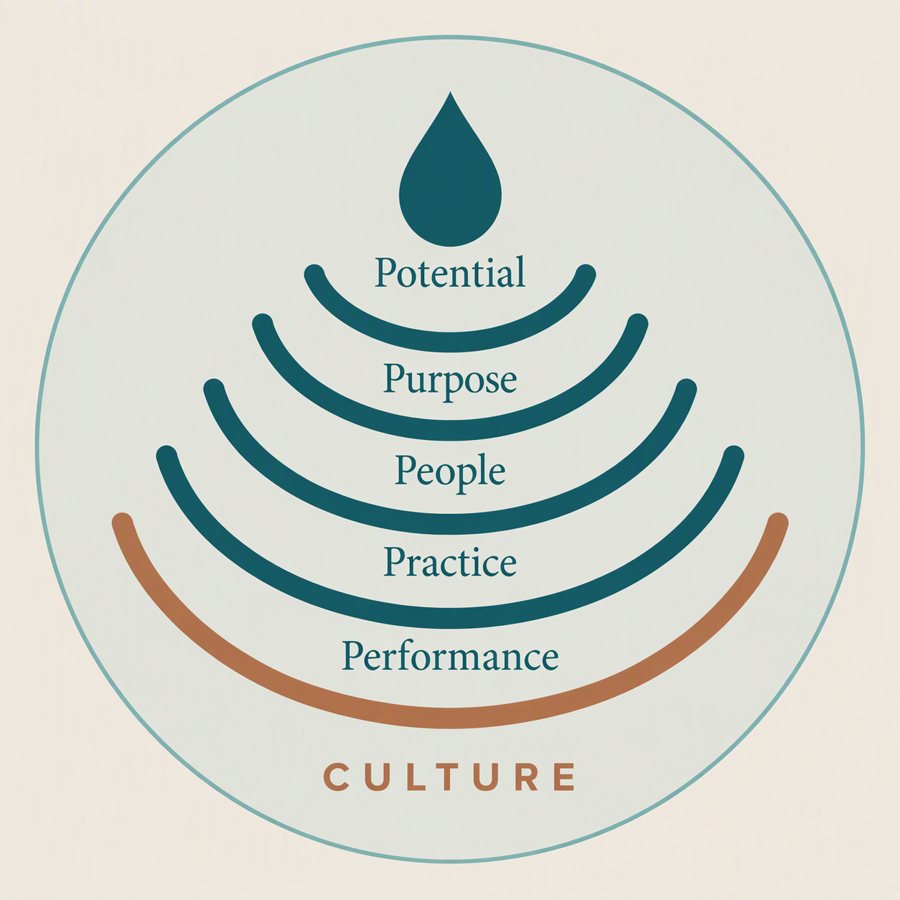
In a talent review, Purpose sets the future the organisation needs. Potential identifies who can grow into it. People provide the sponsors and coaches who open doors. Practice provides the stretch roles that build and test readiness. Performance is the proof, and the business result. Most organisations already have the talent they need for the future. The question is whether their talent reviews are looking for it.
Sources
- Gartner: Succession Planning That Builds the Leaders You Actually Need
- Gartner: Agile High Potential Employee Strategies
- Melanie Hughes, Forbes (2025), citing Corporate Executive Board research: 7 Key Factors for Distinguishing Between Performance and Potential
- Alan Benson, Danielle Li and Kelly Shue, American Economic Review (2026): “Potential” and the Gender Promotion Gap
- McKinsey & Company (2023): Getting executive transitions right